Boundary Theory · Xueqiang Gao
Home / Research map
Research map
The programme's global map of research lines
This figure shows where each research line of the programme currently stands — its programmatic premise, the formalisation work, the evidence behind it, and how it reaches interpretation and application. It is a map of the work, not a single theorem chain.
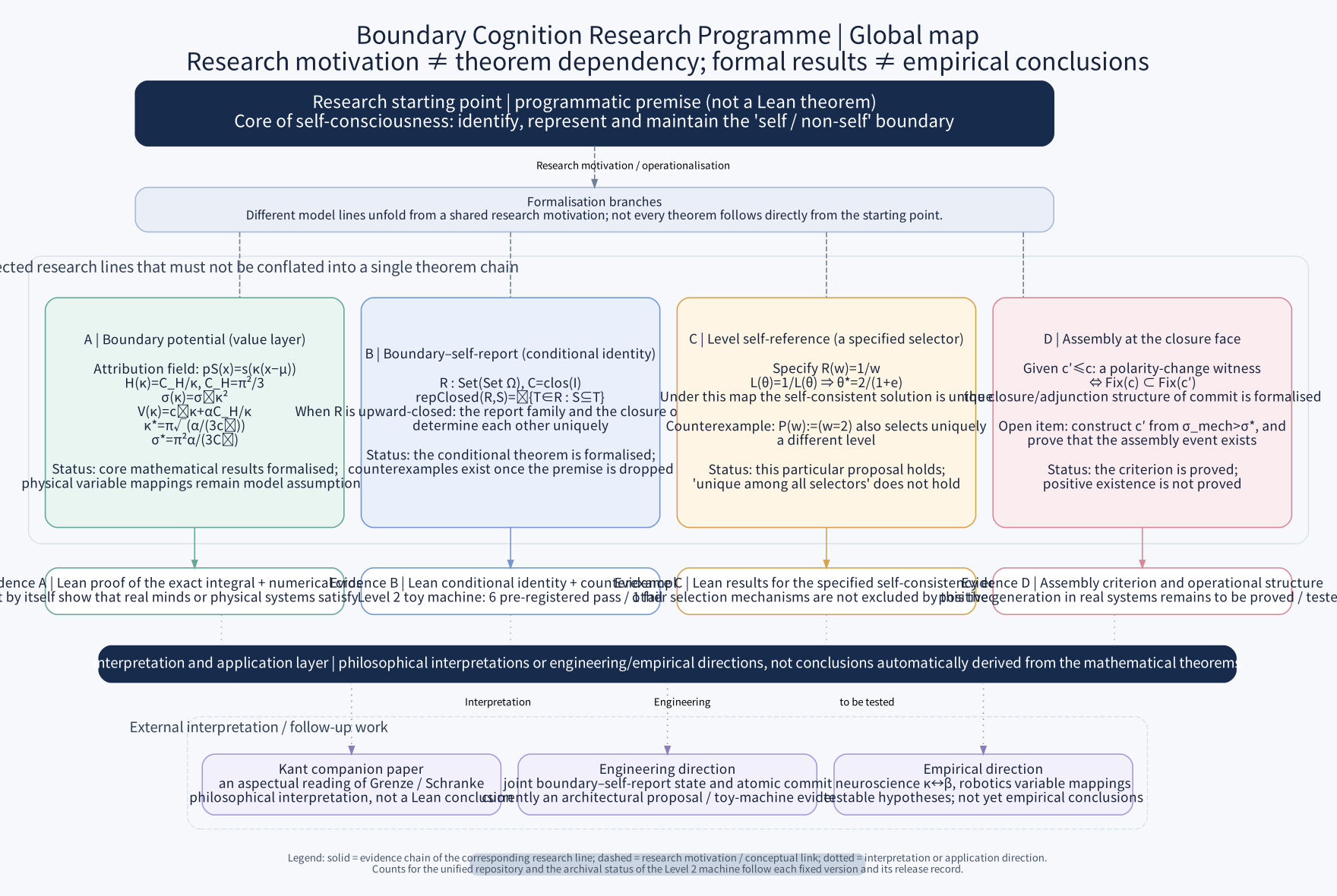
The four layers
Layer 1
Research starting point
A programmatic premise — the core of self-consciousness as identifying, representing and maintaining the self / non-self boundary. This is not a Lean theorem.
Layer 2
Four formalisation lines
A | Boundary potential (value layer); B | Boundary–self-report (conditional identity); C | Level self-reference (a specified selector); D | Assembly at the closure face.
Layer 3
Evidence
Each line's theorem, counterexample, or unfinished item: Lean proofs, numerical cross-checks, the Level 2 toy machine, and open construction problems.
Layer 4
Interpretation and application
Kant companion reading, engineering direction, and empirical direction — philosophical or engineering / empirical proposals, not conclusions derived automatically from the theorems.
What the arrows mean
| Style | Meaning |
|---|---|
| Solid | Evidence chain of the corresponding research line. |
| Dashed | Research motivation / conceptual link — not a mathematical derivation. |
| Dotted | Interpretation or application direction. |
Status note
This map describes the state as of 2026-10-19. Counts for the unified repository and the archival status of the Level 2 machine follow each fixed version and its release record.
Downloads
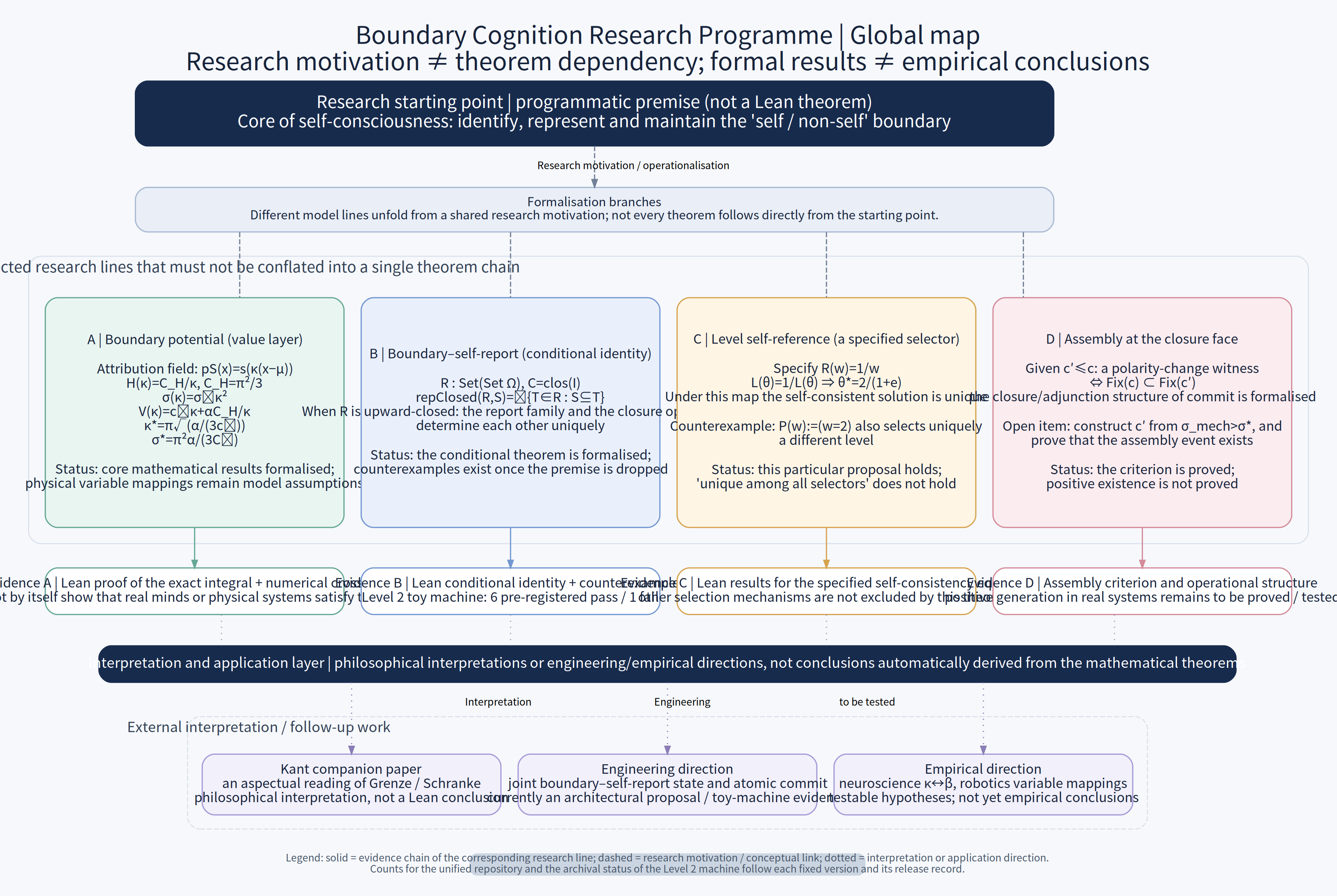
SVG: boundary_programme_map.en.svg · PNG: boundary_programme_map.en.png
Related
How to challenge this work · Machine-checked results · Scope