What is machine-checked, and how to reproduce it
The real question on this page is not how many theorems there are. It is which statements carry a machine-checked proof, and which do not. A count is a marketing number; a boundary between proved and unproved is a scientific one. So the page is organised around that boundary — and it ends by disclosing, rather than hiding, a disagreement about the counts themselves.
What is machine-checked
Two corpora of Lean 4 carry proofs. They are different bodies with different scopes, and they are not interchangeable.
| Corpus | What it proves |
|---|---|
| The categorical layer (CausModel) | The intervention category and its universal property; cohesion as an idempotent monad; the boundary as its fixed point; the defect as a decidable obstruction class. The layer has zero , zero . |
| The value layer (frozen) | The 33 frozen declarations — 27 theorems and 6 lemmas over 7 definitions — formalising the logistic coordinate instance: the two-term potential, the exact derivative identity, the sign trichotomy, both limits in – form. |
| The bridge | Transfers the categorical layer's "the form is forced" theorem and its non-categoricity negative result onto the value layer's central object. |
What is not machine-checked — and cannot be
| Item | Why it cannot be |
|---|---|
| The variable identification ( stiffness, and its companions) | It is an assumption about the world. No formalisation removes it. Mapping hypothesis |
| The interpretive residue | Reading the conserved charge as self-continuity is interpretation, and is tagged as such. Interpretation |
| The numerical tables | They are deterministic computation, not machine proof. Running the numbers is not proving a theorem. Computation |
Machine-checked exactness and empirical confirmation are different achievements. This work holds only the first, and says so.
Reproduce it
cd lean && bash build_lean_all.sh
A full reproduction requires Lean 4.33.0 and Mathlib of the matching version. The script compiles every module, then the single importable entry point, then runs the zero- check. Two auxiliary scripts verify the frozen manifest and the declaration counts.
The 33-declaration dependency graph
The machine-extracted dependency graph of the A-module BoundaryTheory: 7 definitions and 33 load-bearing declarations (40 nodes / 72 edges / 5 layers), from the boundary potential to C_H = π²/3.
Read it in 60 seconds: definitions → the potential/force cluster and the entropy/integral cluster → C_H. The two clusters share almost no intermediate result; the graph exposes that structural seam. Note: the B-line seam and no-go are not in this graph.
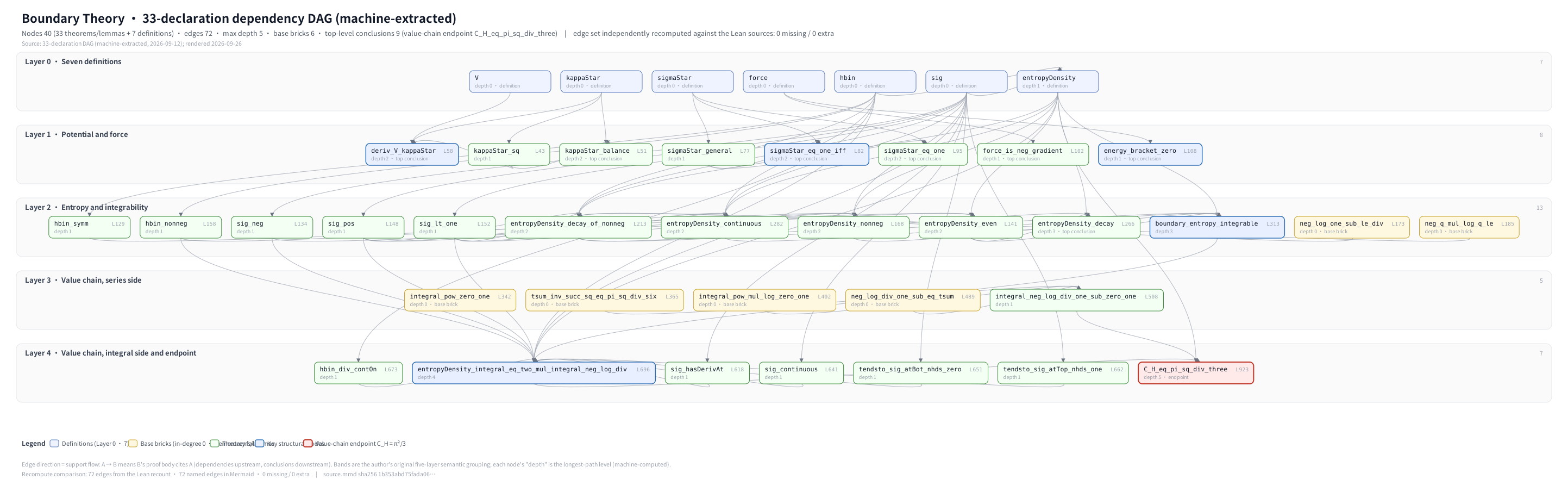
Current external statement (2026-10-19 unified audit): unified body 56 files / 467 theorems+lemmas / 90 definitions; Paper B slice 53/417/77; A module 1/33/7. The table below is the historical four sets plus one direct measurement, kept to show the divergence in counting standards.
The counts disagree, and that is disclosed here
The programme's own documents report four different sets of numbers for the same corpora. Measuring both corpora directly, on 2026-10-09, gives a fifth. Rather than pick the flattering one, all of them are listed.
| Corpus | Source | Claimed |
|---|---|---|
| Categorical layer | the paper | 124 declarations · 12 modules · cold build 3333 jobs |
| the line's own audit notes | 155 declarations · 14 modules · 3335 jobs | |
| direct measurement (2026-10-09) | 107 theorems / 49 definitions / 15 files | |
| Boundary programme body | the line's own summary | 417 theorems · 77 definitions · 53 files |
| direct measurement (2026-10-09) | 434 theorems / 84 definitions / 55 files | |
| Value layer | the paper and the summary | 33 declarations — the only figure on which everything agrees |
Status of every claim on this page
| Claim | Status |
|---|---|
| Both corpora compile with zero and zero | Machine-Checked |
| The 33 frozen value-layer declarations | Machine-Checked |
| The bridge theorems | Machine-Checked |
| Any declaration count | Disputed — four published sets |
| Any statement about a real system | None exists |